Showing posts with label ramble. Show all posts

Sunday, July 26, 2015

The Ramble: On skepticism, questions, and faith

Over the past few years, I've thought quite a lot about spiritual questions, skepticism, and faith. This post is an effort to write out some thoughts about how I approach questions and doubts about religion and spirituality, and more specifically about the Church of Jesus Christ of Latter-day Saints.  I expect that most that will read this are deeply familiar with the Church, and so I have used a lot of terminology that Mormons will understand without taking space to define terms.  To those who may read this that are not familiar with Mormon terminology, I apologize in advance, and encourage you to visit www.mormon.org to get the basics on anything you don’t understand, or you can contact me directly.

I also want to say upfront that this is quite long.  I do not think I could do it justice without taking up a fair bit of space.  I sincerely hope that it is worth taking the time to read.

With that brief intro, here goes:

The back-story

My entire life I have been filled with questions.  Jenn's family to this day pokes fun at me for always wondering about the world and how and why it works.  I view it, in all seriousness, as a gift from God to be curious by nature.  Very few things in the world fill me with as much excitement as digging in and really getting to the bottom of (almost) any question.

It was probably on my mission or shortly before it when I discovered that there are a myriad of questions about religion, the Church, and the gospel, and that it was okay and even enlightening to ask them.  I guess up until that point I had kind of had the mindset that whatever was taught by my parents, in Sunday school, or in seminary was just true and there wasn't anything deeper to understand.  I want to highlight here that I'm talking about asking questions, which is different from having doubts.  I simply wanted to know more about almost anything, from the trivial (did Laban have literally the ONLY set of scriptures in all of Jerusalem??) to the vital (why must faith precede hope?).  I've used these kinds of questions as my main method of studying the gospel for the past 15 years or so, and it has been extremely fulfilling and enriching.

Now, my profession as an academic is all about asking (and, hopefully, answering) questions as well.  But a big part of getting a Ph.D. is also learning to be something of a skeptic.  I would say that the default for most academics when they read or hear something new is to be skeptical first, to "lead with their unbelief," to borrow a phrase from Elder Holland.  I don't think this is necessarily bad, either.  Being critical and skeptical of yourself and others forces the researcher to explore every possibility and to be sure of something before promoting it too much.  This leads to better research overall.

It's natural, then, when you're getting a Ph.D., to start to become skeptical towards religion as well.  In fact, it almost feels disingenuous not to.  After spending all week doubting other's work, why is it okay to suddenly have faith on Sunday?  Shouldn't you put these critical reasoning skills to work in religion as well?

At first, these kinds of thoughts made me uneasy.  It seemed like a sure path to losing my testimony, which was the last thing I wanted.  So, I basically avoided them.  But you can only put those kinds of things on the shelf for so long; at some point you must confront them.

Two key insights

The short of it is that I'm still a firm believer.  I happily devote and dedicate myself to Christ and His teachings and His church, and in many ways I feel that my faith is stronger now than before, although it had to pass through some shakier times to get there.  I'm not going to chronicle that journey here, although I give two short examples below.  Instead, what I want to do is lay out two key insights that have helped me reconcile my professional and spiritual life, and see just how similar they really are.  These two ideas are my starting points for any doubt I might have about the Church.

1. We know almost nothing about almost everything.  This has been one of the most startling discoveries for me of the past 8 years.  While getting my undergraduate degree, everything I learned was presented as, "this is the way the world works."  It seemed that we knew SO MUCH about SO MANY things!  But that is a complete illusion that stems from the fact that undergrad classes are designed to give you a solid base, not to teach you what we don’t know.  In grad school, I first started to get a sense of the vast unexplored wilderness of the unknown of economics.  I realized that in economics at least, we know almost nothing.  For all we know, most of our economic policies might be as effective as bloodletting was to cure high blood pressure.  And then I realized that this is probably true in almost every field of inquiry.  Think of the things we've discovered in the last few hundred years!  Think of how hard it was to convince the skeptics in Copernicus' time that the sun and not the earth was at the center of the universe!  And then think of how wrong Copernicus was to think that the sun was at the center, when really we're in the outer rim of just our galaxy!  In all likelihood, we're way off in our understanding of most things that we "know," because we only know a small piece of the full picture.

This is true in spiritual matters as well.  For whatever reason, God has chosen to reveal very little to us in this life.  The Plan of Salvation, wonderful as it is, is pretty light on the details.  The scriptures have been interpreted (and, sometimes, misinterpreted) for centuries, and cultures and contexts have changed so dramatically that it's hard to know their exact meaning.  And all prophets in all ages have mostly spoken to us about a select few topics anyway (faith seems to be a popular one...must be important!).

This means that with anything that is unclear or hard to understand, there is a high likelihood that we don't have the whole picture.  In any disagreement between two "truths" it is not necessarily the case that one is right and one is wrong.  It could be that both are right, and we are missing more understanding that would make the pieces fit together.  It could be that both are wrong.  It could be that they are partially right and partially wrong.  We just don't know enough about most things to be able to rule very much out.  Both academic and spiritual learning are muddied by missing information, years of history, and limited mental and spiritual capacity.

2. All knowledge is based on faith. Because we know so little, with anything that we study we always have to start with faith.  Religious study usually starts with faith in God, or maybe even just a desire to believe in Him (Alma 32:27), and builds from there.  Nephi said that he didn't know the meaning of all things, but that he knew that God loves His children (1 Nephi 11:17).  That's a place to start, and then we can build from there.  We learn more by "experimenting on the word" and then observing the results.  But it all has to start with faith in something.

The interesting thing is that secular knowledge is exactly the same.  We know very little, and so we start with faith, and then go from there.  Of course, in secular learning we don't call it faith.  Instead, we usually call it an assumption or a conjecture.  But it comes down to the same thing.  For example, scientists start with the assumption that nature follows laws that can be described by mathematical formulas, and that these laws are constant.  A few hundred years ago, it wasn't a given that this was true.  Newton conjectured that gravity might be one of those laws and now, from many experiments we know that things on earth fall at an acceleration rate of about 9.81 m/s^2, so gravity must be a constant law.

The crazy thing is that even something that we understand as well as gravity doesn't seem to work all of the time.  A little less than two decades ago, it was discovered that our universe is expanding at an accelerating pace, exactly opposite of what gravity would predict.  That's like throwing an apple in the air and having it fly away from you faster and faster, rather than falling back down to earth.  It was completely unexpected - so much so that the scientists who discovered it thought that their data was wrong.  They've now won a Nobel Prize.

When this discovery was made, did physicists all throw up their hands and lose faith in the ability of mathematics to describe nature?  Did they reject gravity as a universal law?  Of course not!  Rather, they assumed that there was something else out there that they just didn't understand yet.  They still have faith in gravity and other physical laws because centuries of experience has taught us that eventually things will work out and will make sense, and that this is the best way to understand the physical world.

In my own field of study, I go on faith all the time.  All main economic principles are based on mathematical models of how people make decisions.  But, these economic models are approximations of reality.  We cannot prove them in the real world because the real world is far more complex than any model can capture.  That doesn’t mean that the models are worthless.  It just means they are light on the details.  Basically, I take it on faith that what the models say is true, or at least approximately true.  I then look for evidence using whatever methods I can to see if the evidence lines up.  Whether it does or it doesn’t, that is an opportunity to learn more and get closer to the truth.

A quick example: a basic principle of economics is that free markets will generally lead to more economic prosperity.  I could spend all of my time running around saying, “you can’t prove that!”  And, it’s true, we can’t.  But if I waited for 100% proof, I would never be able to move from the basic idea that free markets are efficient to anything more complex or nuanced, such as the idea that free markets are efficient but only if contracts can be enforced.  Basically, I start with the idea that free markets are good, look around at the evidence I do have which is heavily on that side, and move on to the next thing.  My faith, in spite of the fact that something isn’t proven 100%, allows me to progress in knowledge and understanding.

Bringing it all together

To sum up: we don’t know very much about most things, and because of that all knowledge is based on faith.  Therefore, when I’m faced with something that goes against what I used to believe, it doesn’t necessarily have to destroy everything I used to know.  I first have to acknowledge that I don’t have complete information, and so making all the pieces fit perfectly together just isn’t going to happen right now.  And then, I remember that this new piece of information is based on faith, as is my old information, so it’s not a competition between science and faith. 

That doesn’t mean that I can or should ignore new pieces of evidence.  That is blind faith, and I don’t want to have blind faith in either science or religion.  Rather, when some new piece of information comes along, I weigh it as new evidence to go along with all of the old evidence I have on some topic.  I try to see how it might fit in, and I remember that none of the evidence is exactly perfect, so I should not be so dogmatic and close-minded as to simply reject things out of hand.

I feel like so often, when something challenges someone’s worldview, they feel like they either have to hold fast to their old views or completely abandon them for the new ones.  Knowledge and learning is line upon line!  Little by little!  Right now we “see through a glass, darkly” (1 Cor. 13:12), not in clean black and white.  Because of that, I think we should be cautious about allowing a single thing to dramatically alter our beliefs.

Example 1: Genetic evidence and the Book of Mormon

I have given a couple of examples above of cases where scientific beliefs are based on faith and how new information does not necessarily destroy those beliefs.  I want to share also a couple of examples of how I have dealt with questions and doubts about spiritual matters as well.

The first is a straightforward conflict between what science tells us and what religion tells us.  On the one hand, the Book of Mormon claims that at least some of the ancestors of the Native American people were from the Middle East.  Meanwhile, our best genetic evidence shows that Native Americans are most closely related to people from East Asia, leading to a theory that they crossed over to the Americas via a land bridge near present-day Alaska.

There is a conflict here, so how do I deal with it?  First, I have to remember that scientific evidence is not irrefutable.  Scientific findings get overturned all the time, so I should not just abandon my faith in the Book of Mormon because of this apparent conflict.  Indeed, my limited understanding is that our best genetic evidence is based on precious few sets of DNA from centuries ago, combined with complicated models of how that DNA might evolve over time.  Second, I also remember that Mormon himself wrote that he wasn’t able to write even 1/100th of the things that occurred during their time.  We don’t have the full picture in the Book of Mormon, and maybe some of the pieces that would help reconcile these two pieces of information are simply missing right now.  For example, we don’t know what other groups of people lived in the Americas that the Nephites and Lamanites came into contact with.

Thus, I go on what I know: I know that I have no explanation for the Book of Mormon other than Joseph Smith being an absolute genius such as the world has never seen, or that it is from God. I know that when I live by its teachings I am happy and fulfilled, and that when I mess up I am not. I know that I have felt for myself the Spirit testifying that it is true, and that many others whom I respect and love have felt the same.  I take all of this evidence, and the small conflicts about genetics don’t trouble me too much because I recognize that we lack complete information on those issues. Thus, I continue to believe that the Book of Mormon is from God, and then I wait for more information.

It turns out that in this case, a small bit of further information has come.  A couple of years ago National Geographic published an article about a “great surprise:” new evidence from the genome of a 24,000-year-old Siberian youth suggests that up to 1/3rd of Native American genes are of Western Eurasian descent, rather than entirely from East Asians as previously believed.  Thus, it now appears entirely reasonable to assume that at least some ancestors of the Native Americans were from the Middle East.

Again, this new piece of information is just a piece of evidence!  It may switch again, and again, as we learn more.  Thus, it does not fully confirm or deny the story in the Book of Mormon; it just sways things back in the direction of my own beliefs.  Most importantly, however, it demonstrates how things that we “know” will change as new things come to light.

Example 2: Learning more of Joseph Smith’s history

As with most people that grow up as members of the Church, I have always revered Joseph Smith as a man of God and the prophet who restored the gospel.  I still do.  But I think that I was taught a rather glossed-over version of his history in my youth, mostly because that’s the history that Church materials present.  (I think this is slowly changing, which I applaud!)

Thus, it was a bit of a shock to learn more about his past in the small bit of reading I have done about him outside of the standard Church materials.  For instance, Rough Stone Rolling tells of him looking into a hat to translate the Gold Plates, which was something I had never heard before in my life.  I have also learned of him going to look for gold in various places, and other things that he did in setting up the Church that appear to be mistakes or errors of judgment (such his failed financial ventures). 

This challenged my worldview of Joseph Smith, whom I had envisioned as a near-perfect man.  The question is: what do I do with this new information?  The answer is that it depends a lot on how I approach it.  If I were starting from a position of not believing that Joseph Smith was a prophet, and looking for confirming evidence of that, I could probably take these things that way, and it would weaken or even destroy my faith.

But I can also take this same evidence and use it to further cement my faith that Joseph Smith was a prophet.  Specifically, instead of asking, “How does this show that Joseph Smith was not a prophet?” I instead ask, “How does this change what I know about prophets?”  Notice that I’m taking all of my previous knowledge and faith and beliefs about Joseph Smith, and using it as a starting point, just like I do when I study economics.  When approaching the question from this angle, the new information is enlightening, not faith-destroying.  If you think about it, the fact that Joseph Smith looked into a hat isn’t any weirder than him looking into the Urim and Thumminm.  Is it that odd that he went looking for gold, given all of the gold rushes we know about in California, South Dakota, the Yukon, etc.?  Not really.  Rather, I now better understand that the Lord works with prophets as real men, who might feel more comfortable looking into a hat or who might be easily swayed by tales of gold.  I think of how often the Lord has let me fail and mess up, even in my church calling, and I understand that it is no different even for a man of Joseph Smith’s stature.  In fact, learning this history has increased my appreciation of what God can do with prophets, because I marvel even more at the temples, the Book of Mormon, the Doctrine and Covenants, and all of the other things instituted through an imperfect man. 

What I believe

Hopefully, those two examples give small illustrations of how my faith evolves as I ask questions and encounter new information.  I want to say clearly that I believe that the Church of Jesus Christ of Latter-day Saints is the true church.  I believe this not because I have a perfect knowledge of all things, but because all of the evidence in my life to this point tells me that there is a God who loves me, and that when I live His commandments I am happier and my life is better.  Some of that evidence is observational and scientific, and of course a lot of it is based on my own personal spiritual experiences  One of the difficult things about that spiritual knowledge is that each person needs to have their own experiences with the Spirit.  I cannot give you the data and let you do the analysis as I could with a hard science.  But that doesn’t make it less true or less important!  It just means that others have to find that evidence for themselves.

By recognizing that faith is not a perfect knowledge, I also recognize that my faith and beliefs are (and should be!) evolving and changing as I learn more.  That process has been an enlightening and uplifting one as long as I have been humble and prayerful.  It can also be frustrating, as it means that I always have many open questions that I simply have to put on the shelf and wait for an answer. But I believe that the Lord is willing to pour down knowledge (see D&C 121:33) as soon as I am ready for it.  I know that as I go through that process, my light slowly becomes “brighter and brighter until the perfect day.” (D&C 50:24).


That’s what I believe. 

Tuesday, March 04, 2014

The Ramble: Should we raise the minimum wage?

The current federal minimum wage is $7.25.  A person working 40 hours per week on that wage would earn $14,500 per year, which actually puts them above the official U.S. poverty line for a 1-person household.  But still, that's a pretty paltry amount for a full year's work, and Obama has made it a central goal this year to raise that minimum wage level.  In fact, a couple of weeks ago he signed an executive order raising the minimum wage for federal contract workers to $10.10 per hour--a whopping 40% raise for these workers!

But should we raise the minimum wage?  How much would it help?  Who would it help?  And, how much would it cost?

The Econ 101 Story

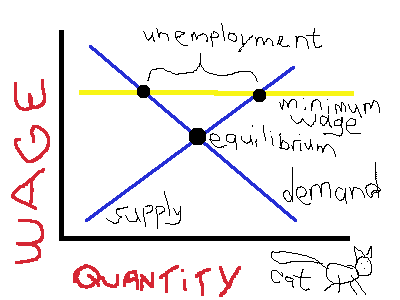
Economics 101 says that price controls always cause what economists call deadweight loss--they destroy economic value.  Minimum wages could do this in the following way: Suppose that there is a worker, Bill, who can produce $8 of value per hour for a company.  Suppose also that Bill knows that he is worth $8 an hour, so he is willing to work for nothing less.  Luckily, the company is just willing to hire him at this wage, so he gets hired and takes home $16,000 in pay per year.  To liven up the example, let's say he works for Wal-Mart, a company that took in $16 billion in profits last year.

It's easy to look at this and say, "Wal-Mart so much money!  Bill worked hard!  He deserves more!"

But, what would happen if we raised the minimum wage to $10.10, as Obama proposes?  Bill would lose his job, because he only creates $8 of value for Wal-Mart per hour.  If Wal-Mart continued to employ Bill, they would lose $2.10 every hour that he spent at work!  Wal-Mart actually has a legal obligation not to employ Bill at $10.10, since they have a fiduciary duty to create as much value for their shareholders as possible.  Hiring Bill is essentially stealing $2.10 from shareholders for every hour that Bill works.

Here's a nice picture of the effect:


The deadweight loss comes from the fact that Bill is now unemployed, and Wal-Mart will not hire someone to replace him.  The economy as a whole shrinks as a result.

That's the Econ 101 story, and it would prescribe that we shouldn't have a minimum wage at all, because it hurts everyone involved.

The Econ 201 Story

But here's the Econ 201 story: What if an employer has some kind of market power?  Let's modify my example above a bit: What if there are 1,000 people identical to Bill out there, and the only company they can work for is Wal-Mart?  In this case, Bill knows that he creates $8 of value for Wal-Mart, but he can't insist on getting $8 per hour because there are 999 other unemployed Bills out there who would happily take his job for $7.99 per hour.  And, if Bill loses his job he can't get hired elsewhere, and earning $7.99 an hour is better than getting nothing, right?

Of course, if you follow this logic, you can see that Bill will end up working for something far less than $7.99, because of course all of those other workers are willing to work for something a lot lower than $7.99.  His wage will end up getting pushed much lower because Wal-Mart has all of the bargaining power, since they're a monopsonist--the only place where people can work.

But, if there is a minimum wage, Bill knows that at least his wage won't fall below $7.25.  In this way, the minimum wage takes away some of Wal-Mart's power, and saves Bill by putting a floor on his wage.  In this way, the minimum wage is actually value-creating, because Wal-Mart will end up hiring Bill for $7.25, and for some other reasons (that aren't really necessary for me to cover here) it will also be more willing to hire some of Bill's friends as well. 

Of course, if the minimum wage is raised to $10.10, Bill will still lose his job, because he only creates $8 of value per hour.  But, now imagine that there is also a worker named Sally who works at Wal-Mart.  She creates $10.25 of value per hour, but has been getting paid far less than that because Wal-Mart has market power.  Raising the minimum wage is great for Sally, because she'll earn far more and it takes away Wal-Mart's ability to underpay her.  So, at the end of the day, when we raise the minimum wage it hurts Bill, and helps Sally.  Whether the overall effect is positive or negative is hard to pin down--and it depends on how many Bills and how many Sallys are in the economy, and what their options might be should they lose their jobs.

How many Bills and how many Sallys are there?

So, if you want to make an argument for raising the minimum wage, you have to argue that there are a lot of employers out there that are monopsonists who are underpaying their workers, and that there are a lot more Sallys out there who are getting severely underpaid than there are Bills who would end up losing their jobs with a minimum wage increase.

And that's why the minimum wage issue is thorny.  Obama can say things like, "We are a nation that believes in rewarding honest work with honest wages," but the implicit argument he is making is that there are a lot of employers who are not paying their workers "honest wages."  Is that really the case?  I don't know, but to me it certainly doesn't seem like there are too many companies out there that have complete market power over workers.

A recent report by the Congressional Budget Office (CBO) tried to put some numbers on this.  Under a scenario in which the federal minimum wage was increased to $10.10, they estimate that:

  • 500,000 people would lose their jobs (these are the Bills in my example above).  Keep in mind that this is an estimate and that it could easily be as many as a million, or as few as zero.
  • 16.5 million people would see their wages increase (these are the Sallys in my example above)
  • On net, 900,000 people would see their incomes rise above the poverty line
So, clearly a lot more people would see their wages increase that would lose their jobs.  On net, then, would this be good?  Should we do it?

Why I'm against raising the minimum wage

I say no, and there's three main reasons why:

  1. Losing your job is much more painful than getting paid a bit less than you actually should.  While 16.5 million people would see their incomes rise, for most their income isn't going to go up by much, and at the same time you're going to have half a million people drop all the way to zero.  I think it's especially important to think about what Bill might do when he loses his job.  Remember that he was already the low-productivity worker, even compared with Sally.  The people that will lose their jobs are precisely the most vulnerable--those with the lowest skills, and the least chance at finding an alternative profession where they can get hired.  Sally, remember, is worth at least $10.10 per hour, and is much more likely to be able to switch jobs than Bill because she has some abilities that increase her productivity and probably make her more marketable.
  2. Raising the minimum wage is poorly targeted to help the poor.  A recent paper shows that only 11.3% of workers who would see their wages increase due to a minimum wage hike live in poor households.  Meanwhile, 63% of those that would see their income rise are second or third earners living in households with incomes at least three times above the poverty line.  So, yes, we would see 16.5 million people have higher incomes, but most of those people are already living in households that aren't poor.
  3. It will cause deadweight loss.  Not only is raising the minimum wage poorly targeted to help the poor, but raising it will slow growth in the economy, which also disproportionately hurts the poor.  Put differently, this isn't just a transfer from employers to employees as they have to pay more wages, but actual value is just lost when the minimum wage rises.  This effect isn't captured in the CBO estimates above, but some recent evidence suggests that in the long run rises in the minimum wage slow job growth significantly.
I'm all in favor of helping the poor, but raising the minimum wage just isn't the best way to do it.  Why don't we focus our efforts on re-vamping the food stamps program, or creating a more effective way for unemployed people to get re-training?  Or, in training people better in the first place?

Wednesday, October 30, 2013

The Ramble: Does Studying Economics Breed Greed?

My good friend Brittany passed on this article that asks whether studying economics makes you more greedy.  She did make it very clear that she didn't think I was greedy, so I guess I'll try not to take offense and see if I can provide some useful thoughts about this subject.

You should read the article that I linked above if you can; it's got some interesting facts and details in there.  The main gist, though, is that people who study economics:
- Are less likely to donate to charity
- Accept greed in others more willingly
- Aren't as fair when dividing money with peers
- Are more selfish in terms of free-riding off of others

Reading through that list of facts, things look pretty bleak for economists.  We're all a bunch of self-centered jerks, apparently.  :)  But seriously, after thinking about this for a few days I've settled on three main points:
1. There's no reason that studying economics should make people greedy.
2. There are several alternative explanations for the above facts that suggest that the above findings are a bit overblown.
3. Even so, I bet it is probably true that studying econ breeds greed to some extent.  I think this is likely due to a couple of key misunderstandings about econ in general, and it reflects poor teaching of econ at the introductory level.

If you're interesting in my take on each of these points, keep reading:


1. Should studying economics make you more greedy?
There's a common misconception (held by economists and non-economists alike) that economics teaches that "greed is good."  This concept comes from a basic principle of econ taught by Adam Smith himself: "It is not from the benevolence of the butcher, the brewer, or the baker, that we can expect our dinner, but from their regard to their own interest."

But you have to be very careful with this idea.  Let me try to state exactly what economics teaches as clearly and cleanly as I can:

In a market where everyone pursues their own self interest, and in which no other frictions are present, assets will be allocated to their most efficient uses.

This is a remarkable statement that demonstrates the amazing power of markets, but if you read it carefully it never says that pursuing self interest is what one should do.  It just says that if we assume that people will pursue their own self interest, then assets will be used in the most efficient way possible.  Also, the idea of "acting in your own self interest" is actually quite broad and could easily include donating to charity if that makes you happy or better off in some way.  In some cases, economists will explicitly include charity or service in their models when they feel that those items are important.  For example, if you're modeling retirement savings, the desire to leave an inheritance for your kids is important and must be taken into account.  But most academic studies ignore charitable acts and make the simplifying assumption that everyone strictly acts in their own self interest.  This is not because this is what economists think everyone should do, nor is it because economists think that everyone does act in this way.  It's a simplifying assumption to make the model simpler, and most of the time it's close enough to be quite useful.

One other quick point:  Note that the above statement says nothing about fairness or ethics at all.  In this hypothetically efficient market that we're thinking about there could very well be people who die of starvation, despite the fact that everything is allocated to its most efficient use.  Clearly, no one thinks this is right or is what should happen, but this basic principle doesn't have much to say about fairness.  Each economist is going to have a different opinion on what is fair, and in most cases you can't prove that one opinion is better than another when it comes to ethics.  Because of this, most of economics steers clear of moral issues and tries to just focus on things that unambiguously make everyone better off.

2. Are there reasons to think that the evidence that studying economics breeds greed is wrong?
So far, I've tried to make the case that studying economics shouldn't necessarily make people more greedy.  But there is a substantial amount of evidence that suggests that economists are more self-centered than others.  Is there any reason to doubt this evidence?  I think that there are three things to keep in mind, that should at least temper your nasty thoughts about economists:
  • First, pretty much all of the studies that are linked in the article above only show a correlation between studying economics and greed.  There is no strong evidence that study economics causes greediness.  In reality, there is likely a lot of self-selection going on.  Lots of people that study economics are doing so because they are business men and women who are naturally focused on succeeding and turning a profit--a.k.a. somewhat greedier than others.  If this is the case, it would make economists more self-centered than others, but it wouldn't be because they studied econ.  They were already that way by nature.  Of course, that doesn't speak well of those who study econ in general, but it does mean that it's not the study of econ per se that's causing the problem.  Also, I have to put in a word of defense for the many MBAs that I know.  While most of them are extra competitive, I would also argue that nearly all of them feel that the best way to help the world is by building strong and vibrant companies that produce good jobs and great products.  They want to do well themselves and do well for the world.  I don't disagree with that notion.
  • Second, magnitudes matter.  All of those facts say that economists are greedier than others, but how much greedier are they?  Are we talking huge amounts here?  In most cases, no.  For example, in the study that showed that economics professors donate less to charity than other professors, it turns out that econ professors actually donate more than other professors on an absolute basis.  The authors of the study scale donations by income, and since econ professor earn more than most other academics, this hurts their donation numbers.  But, even scaled by income econ professors donate 91% of what other professors donate.  That's still less, but it's not like they are donating zero.
  • Third, some of those studies are sort of specially designed to trip up people who have studied economics, particularly someone who's studied game theory.  One of the most famous games studied in game theory is called the "ultimatum game." In this game, two players are given a small sum of money.  Player 1 gets to propose a way to split the money between the two players.  He can choose anything: 50/50, 80/20, 100/0, etc.  Player 2 can then either accept the proposal and both players keep the money, or he can reject it, in which case neither player gets anything.  This is precisely one of the games in which it is found that economists tend to keep more money for themselves while offering less to the other person.  "How rude!" you think.  But if you've studied game theory at all, when you're put in this situation you recognize right off the bat that if both players are acting in their own self interest then Player 2 should accept any proposal that gives him anything.  Why?  Because if he rejects the proposal, he gets nothing!  Knowing this, Player 1 should rationally choose to offer Player 2 $0.01, and keep the rest for himself, knowing that Player 2 will accept any offer over $0.  So, if you're an economist who has thought through this problem and you're put in this situation, it's natural to gravitate towards offering less, and indeed they do--13% less according to the study.  But that's very different from asking whether economists would do the same thing in a real-world situation.  This is a carefully controlled game that economists are very familiar with, where their brains will switch to "game theory" mode and will lead them directly to a greedier answer.  It doesn't necessarily follow that economists will be that much greedier in real life. 

3. So, why might studying economics breed greed?
Although I've argued that studying econ shouldn't make you more greedy, and that the studies showing that economists are greedy are somewhat flawed, it's still my opinion that studying economics probably does indeed make people somewhat greedier.  And that's a shame, because it doesn't need to be that way.

Here's the problem: in an introductory econ course, pretty much all that students are able to learn is that when everyone is self-interested markets magically set optimal prices and allocate capital in an optimal way.  There's no time in an introductory course to go through all of the potential problems that make that not work out in real life, and it's easy to get mixed up and think that therefore everyone should act purely in their own self-interest.  Well-taught introductory econ would very carefully and very forcefully make clear that market imperfections and issues of fairness make it so that greed isn't necessarily good.  Unfortunately, introductory econ often isn't well-taught, leading to confusion on that point.

In addition, I think there can be a culture among economists that promotes the idea that if you don't act in your own self interest you are being irrational, and therefore you're an idiot.  I don't run into that very often, and almost never among academic economists, but it's out there.  I'm all for thinking rationally, but that's not the same as being self interested.

There's also a more benign reason why studying econ might make someone less charitable: skepticism of how effective charities are.  When you read papers that show that giving someone $150,000 does not help them avoid bankruptcy in the long run, you start to wonder if charity can really make much difference.  That skepticism might very well lead economists to donate less to charity.

The flip side of that, though, is that many, many economists are dedicating their lives to discovering how to help individuals, villages, cities, and countries rise out of poverty.  We really want to know how to help the poor and the disadvantaged!  In fact, at their core essentially all academic papers in econ are focused on improving economic conditions.  In that respect, you could argue that econ is one of the least greedy professions out there.  We just haven't found the magic bullet to solve inequality and poverty.  Yet...  :)

Let me know your thoughts in the comments.  Or, you can answer this related question, which came from a great conversation with Shug and Paul: Does education make you more liberal, more conservative, or more moderate?

Sunday, September 29, 2013

The Ramble: What does a professor do?


The Ramble has been on a hiatus over the past few months due to the stresses of finding a job, moving, and some incredible summer vacations.  But now it's back!  And, even better, now it's being written by a bonafide Ph.D., who has a real job!

Speaking of that job, today's topic covers a question that I hear fairly regularly when I describe what being a professor is like:  "Okay, so if you don't spend that much time teaching, what exactly do you do?"

It's a fair question.  Before I answer it, let me back up just a bit and give you my preferred job description:

1. Learn things that others have discovered
2. Discover new knowledge
3. Share what you have learned

That pretty much covers everything that a tenure-track professor is trying to do.  (A brief aside: isn't that kind of an awesome job description?  I'm pretty happy to have that be my job)  Now, most people only interact with professors in the classroom, so they envision classroom teaching as being the main part of a professor's job.  In reality, most professors spend far more time on research than on teaching.  For example, this year I'm only teaching 2 sections of a single course.  That's it.  Next year will be the same.  And, since those two sections are in the same quarter, that means that I teach for 10 weeks of the year, and research the rest of the time.  After I've taught the course a couple of times so that I've got the material down, teaching really won't take much of my time at all.

That's not to say that teaching is less important (although, sadly, many professors kind of feel that way), just that it's not where we spend a huge portion of our time.  The reason for that is that creating new, meaningful knowledge is incredibly hard to do, so we spend a lot of time doing it.

And here's where I always get the question, "so what do you do all day?"  My answer is typically, "I do research."  But most people have a hard time conceptualizing how an economist does research.  Autumn's vision of it was me sitting in my office, spinning around in my chair and dreaming up new ideas.  :)  Unfortunately, it's not quite like that.

Really, I do research by following the scientific method that we all learned in 7th grade:
1. Ask a question
2. Do background research
3. Form a hypothesis
4. Test the hypothesis
5. Analyze data and form a conclusion
6. Communicate the results
When I started my Ph.D. five years ago, I was most worried about step #1--I was worried it would be tough to come up with new, relevant questions to ask.  Turns out, I've rarely had a shortage of good research questions that I'd like to work on.  There's just so much we don't know in economics, that good research questions are all over the place.

What's really hard about research in economics is actually step #4.  Unlike "typical" scientists, I don't have a lab where I can actually run experiments to test my hypotheses.  Without a nice, controlled environment, it's often very difficult to really nail down what is causing what in a typical economy.  One classic example of this: we can prove that people that go to more school make a lot more money.  But, is schooling really causing increased wages?  Or is it that people who are smart tend to go to school more and make more money?  The truth is probably a little bit of both, but it sure would be nice to know exactly how much an extra year of schooling is really worth.  It's an important question, but knowing the answer is just really difficult.  To really nail down the answer, we would need to randomly assign some kids an extra year of schooling, and then track them over their entire lifetimes to see how much more they earn.  Obviously, that's just not going to happen.

So, what to do instead?  I spend a lot of my time looking for and exploiting natural experiments--changes to laws, odd rules, companies creating new products--anything that might "naturally" shock the economy that let's me tease out what is really going on.  Once I've found that, it's mostly a matter of collecting data, running analysis and writing a paper about it.  All of that can easily take months just for a single paper, but the key, for most of what I do, is to find that natural experiment.

Once the paper is written, it's still far from being published, however.  At that point, you submit it to conferences and you send it out to people looking for feedback.  Hopefully that feedback is constructive and helps you fine-tune things so that you've got a well-polished paper after a few months.  And then, you submit it to a journal, and pray that the referees (other academics who review your paper) like your work and recommend that the journal publish it.  The refereeing/publishing process can take several more months, or even years at times.  Rarely is a paper published at the first journal it is sent to, and you just keep polishing the paper and submitting it until (hopefully) it sticks somewhere.

And then what?  The paper is finally published, but who cares?  Does it just sit in some obscure academic journal, where no one will ever read it?  Well, I hope not.  Ideally, all of that work you did gets absorbed by other academics, who might start new projects based on your research, or will perhaps incorporate it into their classrooms.  It may even make it into a textbook someday.  Also, I've been surprised at the number of media outlets that regularly cover academic results.  In short, the knowledge really does get out there, as long as it is useful in some way.  Each paper is only a very, very small piece of the puzzle, but I think it really is important to build that knowledge.

So, that's what I do.  Well, that, and spin around in my chair going, "wheee!!!!"  :)


Let me know in the comments if there is something you'd like to have a future Ramble cover.  I'm open to suggestions!


Sunday, September 30, 2012

The Ramble: Which candidate would be best for the economy?


The content of this post probably doesn't matter.  As of this instant, there is a 78.5% chance that Obama's going to win the election.  Unless something really major happens between now and November 6th, I think we're going to get Obama for 4 more years.

This is where I start to get off-topic and talk about how the president can affect the economy.  You can skip this part if you don't want to read a long post, and pick up again farther down...

To that, I say, "meh."  (O-ba-"meh", to be precise).  I think that I'll probably vote for Romney, but I'm not really heavily in the Romney camp.  I think it would be really interesting to put a real business man in office and see what he can (or can't) accomplish.  Being President is a lot different from being CEO, and I really have no idea how effective Romney might have been as President.  I do know that Romney enjoyed pretty high approval ratings in Massachusetts as governor, which is impressive considering how liberal a state this is.  If I do vote for Romney, it will be a vote for the Romney who ran Bain Capital, was a center-right governor of Massachusetts, and managed the SLC Olympics.  I haven't been much of a fan of Romney the presidential candidate, to be honest.  He's had to pander so far to the right that it's kind of disturbing.

At any rate, I've stated before my belief that the President doesn't really affect the economy all that much, so what does it matter who wins?  Well, I think that I need to clarify my stand just a bit.  What I really mean to say is that the President can't effect the economy much in the short run.  In this context, I'm talking about something like 3-5 years or so.  At longer horizons, though, the president can certainly have huge effects.  In particular, the president's stance on education, immigration, trade, taxes, and subsidies all can feed through in important ways into the economy.  Why does it take so long?  Like I said in my last ramble, the U.S. economy is like a huge ship with momentum going in one direction.  Pushing it in another way takes time.  People resist change.  Wages are sticky.  Prices are sticky.  It takes time to change infrastructure to optimally adjust to new laws.  Etc. etc. etc.  To give you some reference, think about the Federal Reserve, which intervenes in capital markets to set interest rates in order to control inflation.  The Fed literally has direct access to the markets--no red tape gets in the way at all.  Further, the markets the Fed deals with are highly sophisticated and respond within fractions of a second to anything it does.  But, the best evidence that I've read suggests that anything that the Federal Reserve does takes about 6 months to start to affect inflation.  That's at the earliest.  Now think of the poor President.  He (or she, someday) gets elected, and then must begin to create some policies.  Those policies have to be negotiated with a huge set of congresspeople from multiple states and parties.  After several months, at best, those policies finally become law.  Now, other sets of people then have to figure out how to actually implement them.  And only then can the economy really start to respond, and it will only respond sluggishly at best.  With most things that a President can influence, it's going to take a couple of years at least before anything starts to react at all, and several more years after that before the full effect might be known.

So, you can't really blame Carter for the recessions of the early 1980s (it was Volcker), nor can you blame Reagan for the relatively good times we enjoyed during his tenure (that was more the natural rebound after Volcker stamped out stagflation).  Bill Clinton sometimes gets praised for the well-functioning economy of the late 1990's.  We had good growth then, but Clinton didn't really cause it.  They were more driven by quick growth in telecommunications (maybe too quick--see the dot com bust in 2000), and relatively good times worldwide.  I will give Clinton credit for instituting NAFTA and for balancing the budget, both of which helped out, but they're not the main drivers.

Anyway, you see my point, hopefully.  This is why I think it's a shame that (a) a President only gets 4 years in office and (b) we judge him heavily based on how the economy does during those four years.

This is where I get back on topic more directly....

Okay, I'm rambling a bit (but this is the Ramble, remember!).  To get to the point: would Romney or Obama be better for the economy?  This is my assessment based only on the economy.  I'm going to try to be completely amoral (not immoral, though) as I go through this--to the extent possible I'm going to try to avoid value judgments, and the only basis for judgment is what is best for the economy as a whole.  Now, I'm also going to be lazy here and not provide a ton of links to back up what I say.  If you want specific links, please let me know and I'll happily look them up for you.  I just don't have time to exhaustively gather up all of the research while I write this.  Okay, here goes:

- Education.  My pick: Romney.  Why:  Obama has criticized Romney for saying that class size doesn't matter.  Well, as it turns out, class size doesn't matter.  At least the best academic literature out there doesn't find any effect of smaller class sizes on student performance.  What does matter? Teacher quality.  If you want your kids to get a good education, hire exceptional teachers.  And to have exceptional teachers, we have to make it easier to fire the bad ones, and we have to pay the good ones more money.  This is something that Romney is more specifically for than Obama.  Also, Romney is quite supportive of voucher programs, which do have some evidence of being effective at improving education.  As for Obama, I like his "Race to the Top" idea.  I hope he keeps that program running.  But overall, I like Romney's plans better here.

- Taxes.  My pick: Romney.  Why: I think that we need lower taxes for corporations, and Romney's in favor of that.  Romney is famous for saying that "corporations are people."  That quote was taken completely out of context, but if you take it in the true sense that Romney was using it, it's quite true.  You can't tax a corporation.  You can only tax people through corporations.  If you tax a corporation, that business will have to lower the wages of its workers, increase prices on its products, reduce investment in the company, and/or reduce dividends to its shareholders.  In other words, the tax gets fed through to people one way or another.  But, by taxing firms at high rates, we encourage firms to relocate elsewhere in order to avoid those taxes, which is the last thing we want.  Much better to tax people directly (in my ideal world, via a consumption tax) than to do it through corporations.  That being said, I'm just fine with letting the Bush tax cuts expire for high-income individuals, so I'm with Obama on that one.

- Immigration.  My pick: Obama.  Why:  Immigrants want to move here because there are greater economic opportunities here.  They want to work.  They are either going to (a) do jobs that people who are already here aren't willing to do; (b) do a better job than people that are already here are doing; (c) create new jobs; or (d) go back home if they can't find work.  (a), (b), and (c) are all good for the economy.  Especially (c), and there is plenty of evidence that immigrants create lots of jobs.  I don't see why people are so intent on keeping people out of the U.S.  As long they'll keep the rules and pay taxes, why not?

- Financial Regulation.  My pick: Romney.  Why:  Despite the financial crisis, I'm still a pretty firm believer that less regulation is usually better.  I'm not convinced that the Wall Street reform that Obama passed is a good idea at all, nor am I convinced that it will actually do anything to prevent a future crisis.  I'm pretty sure that most economists agree with me on this one, by the way.

- Trade.  My pick: Romney.  Why: Barriers to trade such as tariffs, embargoes, or subsidies can only hurt the U.S. economy.  Here's an example: Guatemala is really, really good at producing sugar.  It's pretty much a greenhouse there, so sugar cane grows like crazy.  They also have lots of really cheap labor there to process the sugar cane.  For some crazy reason, we subsidize sugar beet farms in Idaho and sugar cane farms in Florida, and impose tariffs on sugar that is imported from places like Guatemala.  What does that do?  It raises sugar prices in the U.S.  It uses our tax money to pay off sugar producers in the U.S. instead of, say, paying teachers a higher salary.  It means that people in the U.S. are employed in the sugar industry when they could be working in other, more efficient industries.  It encourages candy-makers to relocate to Guatemala where the sugar is a third of the price, so we lose jobs in the U.S.  And, it kills jobs in Guatemala because they can't sell their sugar with the high tariffs we impose on them.  It's kind of a lose-lose-lose-lose-lose situation.  Obama has consistently threatened trade barriers against other countries (notably, China), and has threatened tax increases on U.S. firms that move jobs abroad (which is just a back-door trade barrier).  Romney has also threatened trade sanctions against China (a dumb idea), but other than that appears more free-trade oriented than Obama to me.

- Welfare.  My pick: Toss-up.  Why: I tend to believe that a lot of people are poor due to a combination of a lack of good education and bad luck.  True, lots of them make poor choices as well, but by and large people are poor because they haven't had the same opportunities as others have had.  That's my view, anyway.  In that respect, I believe we need to help these people, and I'm happy to pay higher taxes to do so.  So, that puts me more in Obama's camp.  That being said, I'm not a huge fan of the current system that the government has of helping poor households.  In particular, food stamps and unemployment insurance have terrible incentive structures, and I believe strongly that people respond to incentives.  So, I guess I would say that I'm in favor of income redistribution, but I'd like to see it done differently.  Neither candidate strikes me as being strong here.

I could go on to a few other points, but I'm running out of steam, and that means that you probably are, too.  At any rate, you can see that that puts me pretty squarely in the Romney camp with regards to the economy.  I'm not alone in that.  In fact, here is a list of 657 economists who are for Romney, including 6 Nobel laureates.  I don't believe there is a similar website for Obama.  By and large, what we know about economics just lines up better with Republican ideals, or, at least libertarian ideals.  Not that it matters.  Obama's got it in the bag.

Saturday, September 01, 2012

The Ramble: The four things you should remember while you listen to Romney and Obama

It's been a while since my last Ramble, but it's not for a lack of things to write about!  Just been busy with vacations and getting a dissertation written...

Anyway, as we're right between the two big conventions, and as the election campaigns ramp up for their final onslaught, I wanted to write a quick post about what I think are the four most important things to remember about the economy.  If our elected officials could understand and remember these four things, we'd be in pretty darn good shape.  Here you go:

1. Economic growth solves (almost) everything.  Budget deficits, unemployment, poverty, social security...all of them would be much less of an issue if we could get the economy to consistently grow at a decent rate (like, say 2-4%).  What does it really mean for the economy to grow?  It means that we are producing more with the resources that we have.

2. The President can't do that much to affect economic growth.  Don't get me wrong here, the government is certainly the most important single player in the economy, but in reality the president himself can't really affect things very much.  So, don't let Romney convince you that our poor economy is all Obama's fault.  Don't let Obama convince you that our poor economy is all Bush's fault.  Don't let Romney convince you that he can turn the economy around single-handedly.  Don't let Obama convince you that the improvements we have seen in the economy over the past couple of years are due to his policies.  Instead, imagine the U.S. economy as a very large, heavy container ship.  The president is very small tugboat.  Can the president make a difference?  Yes, but it's small.  What really matters for the direction of that big boat is its engine, its rudder, and Mother Nature.

3. Innovation drives economic growth.  Okay, so economic growth matters.  How do we get the economy growing?  One thing that pretty much all economists agree on is that it is innovation that creates real growth.  New inventions, new technologies, or new combinations of old technologies are what drive our economy forward.  So, what the president can do to have a real impact is focus on policies that create rich environments for innovation.  To me, that means we need a president who will:  (1) Improve education (including retraining programs for people looking to switch careers): someday I'll write a blog post completely about education. I promise.  (2) Loosen up immigration: there is strong evidence that highly-skilled immigrants who come to the U.S. innovate and invent at extremely high rates.  And yet many of them are only able to stay here for college and then are forced to leave.  Why aren't we giving these people visas?  (3) Reduce taxes on businesses: corporate taxes discourage businesses from creating profits in the U.S.  Why on earth would want to do that?  Raise taxes elsewhere to compensate, but we should reduce corporate tax rates (to zero, in my opinion).  (4) Incentivize innovation: I probably need to write another blog post on this one, but the basic idea is the government can do a lot to help ideas transition into actual businesses.

4. The president needs to have a long-run focus, but probably doesn't.  Suppose there was a nation where everyone earned $50,000 per year.  The President of this nation had a choice between two policies.  Policy 1 would cut everyone's income in half today to $25,000 per year, but would guarantee 3% real economic growth for the next 100 years.  Policy 2 would maintain everyone's income today, but economic growth would only be 1% for the next 100 years.  Which is the right choice?  It's a tough call for sure.  Income under policy 1 would be less than that of policy 2 for 37 very long years.  But, by the end of the 100 years, income under policy 1 would be $466,000 per person, whereas under policy 2 it would only be $134,000!  Clearly, policy 1 is the best choice.  But can you imagine cutting your standard of living in half in that first year?  Can you imagine a president (or an elected official) making that choice?  No!  They'd be ridiculed in the press, lampooned by everyone, and never re-elected.  Now, do real presidents face decision such as this?  To a certain extent, yes, they do.  I think that Obama faced exactly this kind of situation right after he was elected.  He essentially had a blank check to write a very large stimulus bill and use it as he saw fit.  He had two options: (1) Spend the money on "shovel ready" project to create jobs now or (2) spend the money on programs that would foster innovation in the long run, such as better education or immigration programs, or using it as seed capital for great ideas that were struggling to make it to market.  He chose option 1 for the most part, and I feel like that was the wrong choice.  Now, I want to be extremely clear: I think a republican president would have done the same thing, so I'm not necessarily trying to throw Obama under the bus for this.  I just think it's a clear example of a president choosing something that creates a short-term bump but has little effect in the long-run.  So, anytime I see an elected official trying to make a smart long-run choice, I immediately like them a lot more, and they're likely to get my vote.  So, watch for that this fall.

Okay, there you have it.  My four big points.  What have I missed?  Anything in particular that you want me to blog about with regards to economics and the elections?

Thursday, March 22, 2012

The Ramble: Financial Innovation You Can Use


A week ago I went to the 10-year anniversary of a group called the Doorways-to-Dreams (D2D) Fund.  D2D's goal is to foster financial innovation that helps out the everyday person; they particularly focus on innovative ways of helping lower-income families.  It's a great group of smart people who really care about making a difference, and I think they've done some really great and interesting things.  You should check out their website if you're interested in some of the projects they've been working on.

Anyway, as part of the celebration, they had a little panel that talked about the direction of financial innovation, and how it can benefit the consumer.  As I listened to them, I thought about how things have changed in the U.S. over the past 50 years, and how innovation might help us address where we are right now.

Think of the financial world that your parents or grandparents functioned in.  How does it differ from the world that we live in today?  If you're like me, the first thing you think of is that finance was a lot simpler 50 years ago.  It wasn't nearly as easy to invest in anything back then, mortgages pretty much came in only one flavor (30-year fixed), credit cards were non-existent, and your employer likely had a pension plan that would cover you in retirement without you ever having to think about it.  There's a lot of financial theory that says that all of the changes that have happened since then have been great for society as a whole.  For example, anyone can get an E-Trade or Fidelity account and invest in a wide array of markets.  Having that option can't be a bad thing, can it?  Or, people now have several options when they look at a mortgage, and that added flexibility can only help the home-buyer.

The idea that additional choices can only be a good thing makes a lot of sense in nearly every context except finance.  How can adding access or options hurt someone?  How can giving them more control over their own lives make them worse off?  And yet, I think that there are a significant number of people who pine for the good old days of plain white-bread finance.  Why do so many of us wish for that?  I think that there are two really big issues that mess things up for people when it comes to finance:

1. Many people lack the knowledge necessary to really manage their finances.
2. We're not quite as clear-thinking and rational as we need to be.  To give just a few examples, we lack self-control and don't save enough or get into too much debt, we're overconfident in our abilities, we are prone to overweight recent events, etc.

If we could solve these two problems, we could have the best of both worlds: great flexibility and variety in financial services, but the ability to use them to our benefit.  That's where financial innovation can step in and hopefully help us out.  And I think there are reasons to be optimistic about the direction things are heading.

Here are a couple of examples of innovative ideas to illustrate what direction personal finance is heading in:

  • Prize-linked savings accounts: instead of earning a tiny bit of interest each month, you are entered into a sweepstakes to win a grand prize.  This makes savings fun, and attracts a lot more people into savings (instead of throwing away their money on, say, lottery tickets).
  • Credit cards with self-imposed limits: You tell your bank to deny your credit card if you spend too much money in a given month, or on a given product category.
  • Competitive savings:  You compete with your friends to save money.  Every time you do something that helps you save money, your friends get a text saying what you did.
  • Investing with Celebrities: You get to put your money in the same fund that, say, George Clooney has his money in, and you can tell all your friends that you invest with George Clooney.

As you can see, people are getting pretty creative, and I think that some of these ideas will actually work really well.  I'm excited to see these things come out and whether they can actually improve people's lives.

The real problem that I see is that nearly all of the new stuff that people are doing focuses on problem #2 above--they sort of trick us into doing what we know we should be doing but can't make ourselves do.  I don't think anyone has cracked the tough nut of how to actually teach people about basic finance.  I'm not talking about derivatives or the Black-Scholes formula.  I'm talking about basics like: How do interest rates work?  What is a stock?  How does inflation affect your finances?  What happens if I file for bankruptcy?  Isn't it kind of shocking to you that we require high school seniors to be able to do trigonometry, but they aren't required to know what a credit score is?  Recent studies suggest that financial literacy in the U.S. is abysmal.  For example, this survey asked people 5 basic finance questions (covering: interest rates, inflation, bond prices, mortgages, and risks).  Less than 10% of respondents got them all right, and for no single question did more than 70% get it right!

I think that entrepreneurs, policy makers, and academics are all still struggling to figure out the best way to education us about personal finances.  It's not an easy task.  Some high schools do actually have personal finance courses, and the research that I've seen indicates that students in those schools don't end up any better off financially that students who didn't have the education.  So, maybe education isn't the way to go about it.  But we need to provide at least a foundation of knowledge, at the very least so that people will know when they need to seek out help.  It's kind of like a high school health class.  I don't know that health classes make us any healthier, but at least we know the basics of how our bodies work and what things will harm them.  We don't have an equivalent of that for finance.

What do you think?  How can we increase the financial literacy in America?  Should it be the government's responsibility?  Can private businesses find a creative (and profitable) way to educate us?

Monday, February 06, 2012

The Ramble: Lewis & Clark


A couple of months ago I finished a stellar book called Undaunted Courage by Stephen Ambrose, about the Lewis and Clark Expedition (the link will take you to my review of the book).  It was utterly fascinating.  As I read it, I kept thinking about how cool it was for those early Americans to have such a vivid and real frontier.  They literally knew almost nothing about what the continent looked like further west than St. Louis.  I kept wondering about the frontiers that we face now, and I feel like they aren't quite as well-defined as they were 200 years ago.

That's not to say that we don't have frontiers now.  There is, of course, space (the final frontier!), and I think that we know relatively little about the deep ocean environment as well.  But beyond physical exploration, we have many frontiers of knowledge.  Cancer research comes to mind very quickly, for example.  How to create green energy in a way that makes economic sense is another frontier that we face.  Pretty much every research institution out there is chipping away at its own frontier in one way or another, and I'm really glad to be a (minuscule) part of that effort.  These frontiers are just as real as the Wild West, but they are perhaps not quite as easy to identify, or they are at least not as widely applicable-- i.e. pretty much everyone in the U.S. had an interest in exploring the West in the early 1800s, but not everyone cares whether I discover some new intricacy of U.S. Bankruptcy Courts.

So, where am I going with all of this?  Well, it's interesting that Lewis & Clark were funded by the U.S. government, to the tune of about $100,000.  That's about $1.5 million in today's dollars, which is a very small amount in the budget of the U.S. government.  But remember that back in 1804, the U.S. was not even 30 years old; it was far from the behemoth that it is today.  This represented a hefty investment by the government, pushed through by a visionary President Jefferson.

And, it very nearly was all wasted.  In fact, it's a miracle that Lewis and Clark actually survived the trek.  Between wars with the Indians and the elements, they were within a hair's breadth of death for most of the journey.  Can you imagine trying to prepare for a journey that would take two years, when you have no idea how hostile the Indians might be, how plentiful the game is, how harsh the winters are, if the mountains are even passable at all, or if there are navigable rivers to help transport your gear?  Lewis and Clark and their men were taking huge personal risks to even attempt this journey.  But Jefferson was taking a huge political risk as well, because if they never heard from the men again, Congress would have been rather upset about losing their $100,000 on a "sure to fail" venture.

We rightly honor and praise Lewis and Clark and Jefferson for their incredible vision, daring, planning, and ability to pull off such a journey.  But what if Lewis and Clark had been slaughtered in South Dakota?  Or frozen to death while wintering in North Dakota?  Or gone over a waterfall in Idaho?  Jefferson would have been ridiculed at the time, and the expedition would be but a footnote in history today.  So, here's my question: was this a good risk to take?  Was it a worthy use of government money?  You cannot justify the trip based on its success--that they succeeded was merely a stroke of incredible good fortune.  Put yourself in Jefferson's shoes in 1804, and imagine the probability of them making it was somewhere less than 10%.  Should he have done it?

I obviously can't answer that question, but it's important to think about because it directly applies to some of the arguments going on today.  Obama made a similar gamble in 2009 when he used part of the stimulus to fund green energy firms.  The poster child was a company called Solyndra, which as you probably know has now gone bankrupt.  A few others have gone bankrupt as well.  Obama has been roundly criticized for writing checks to these companies, only to see them go belly up.  Does Obama deserve any more criticism than Jefferson for their decision to fund these ventures?  I don't think so.  I'm not saying that Obama or Jefferson made the right or wrong decision--that's a tough call for sure.  But it is certainly unfair to judge them completely based on the results, because Jefferson just got lucky while Obama got unlucky.  With decisions like this, you have to judge based on the information that was available beforehand, not on what happened in the end.

More broadly, to what extent should the government be paying for frontier exploration?  To answer this question, you have to think about two things.  First, if the government didn't fund it, would anyone else?  Second, is the government better at picking the right projects than the private sector?  In my opinion, the answer to the second question is usually no.  It takes omniscience to pick the right projects, and the government just isn't all-knowing.  The free market is the closest thing we've got to omniscience, I'm afraid.  That's why I'm often skeptical of efforts by the government to promote particular industries (like green tech, agriculture, or auto manufacturing).

But, there are many instances where the private market would not fund early-stage research that is vitally important for breaking through knowledge frontiers.  This research has value.  Most venture capitalists are not going to fund some quack academic who is studying something that isn't marketable.  This is where the government has a huge role to play, and does so quite well, in my opinion.  A large number of research projects are funded by government grants, and this is needed in order to push the envelope of knowledge.  But, once a project is economically viable, it's time for the government to step out of the way to let the private sector take over.

Wednesday, November 30, 2011

The Ramble: Occupy Wall Street and the Hourglass Economy

Well, it looks like Occupy Wall Street (OWS) has pretty much been completely disbanded at this point, but the fact remains that a lot of people are concerned about rich people and the income distribution.  Here are some thoughts on the topic:

First off, what does the data say about income inequality?  Here's a chart from The World Top Incomes Database that shows the share of income held by the top 1% of earners in Australia, Canada, Germany, Japan, and the U.S. since 1915:
The two things you should really take away from this chart are (1) income inequality has been going up over the past 25 years in all of the developed world and (2) the U.S. has one of the most unequal distributions of developed countries.

Now, the first question you should ask yourself when you see data like this is: So what?  Do we really care if there is a more unequal distribution?  My capitalistic self says no, I couldn't care in the least!  (NB: I also have an equitable, behavioral self which does care, but I'm not listening to him right now!)  What I really care about is whether income is rising or falling absolutely, not relatively!  If the top income earners are making a bazillion more dollars, that's just fine with me as long as the middle- and low-income earners are earning more money as well.  And to me, that's the real problem.  Here's a chart of how income has changed over time for different percentiles of the income distribution (from Wikipedia).  Note that these numbers are adjusted for inflation:
As you can see, income has pretty much stagnated completely for those in the low end of the distribution, while it has taken off for those at the high end.  People at the 10th percentile of the income distribution are making no more today than they were 45 years ago!  Even those at the median haven't seen their incomes rise by much at all.

The question is, why is this happening?  Here are three possible theories:

1. Rich people are exploiting poor people by forcing them to take low wages, stealing money from companies by taking huge salaries, twisting the laws in their favor, and relying on government bailouts to back them up.
2. Individuals at the low end of the income distribution have made some major mistakes, and those mistakes are costing them.  Examples might include: buying houses that they can't really afford, failing to invest properly, etc.
3. The economic forces of technological change and globalization are causing the shift.

As with most theories, there is some truth to all of these, I think.  What we need to be careful of is when we become dogmatic about a single one, so that we're blind to the others.  In this case, I think that OWS has focused completely on #1, and has thus ignored the other two.  In my opinion, #3 is mainly to blame for the big changes in income inequality, while points 1 and 2 are only mere footnotes in comparison.  Let me try to de-bunk #1 and #2, and then I'll explain why #3 is the root of it.

Is Wall Street really the reason that the rich are getting richer?  The truth is that most rich people really don't work on Wall Street.  In fact, only about 14% of top income earners are in finance.  That's a significant portion, but not as high as many people probably think.  Executives (CEOs, CFOs, CIOs, etc.) make up close to a third of the 1%, and doctors make up nearly 16%.  Regardless, if you think that rich people are exploiting poor people, you would have to make several arguments:  First, you would have to tell me what changed in the early 1980s to make it possible for them to do this, since that's when we see inequality really start to rise.  Second, you would have to argue that this happened in many developed countries and not just in the U.S., because inequality is rising in a lot countries (as seen in the top graph).  Third, you would have to convince me that the market for top earners is not competitive.  That is, these CEOs and doctors and bankers are all making much more than they're actually worth, and companies for some reason are not able to hire them for less.  Do you think that Goldman Sachs would pay its hedge fund analysts $400k if it could get them for $200k?  Of course not!  Would shareholders and boards of directors pay their CEO 10x more than an equally good CEO?  Definitely not.  Fourth, you would have to show that rich people are somehow forcing poor people to accept low wages.  Why does Wal-Mart pay low wages?  Because people are willing to work for those wages!  If they weren't, Wal-Mart would pay more.  Wal-Mart is not holding a gun to these people's heads and making them work for peanuts.  Anyway, I think that making a strong case that includes all four of those arguments is going to be very tough to put together.  Are there cases in which rich people exploit poor people in some way?  Yes.  Are there enough of them to cause the kind of movements shown in the graphs above?  No.

So much for theory #1.  What about theory #2?  I actually think that this is a very important idea.  I believe that the poor get stuck in a trap whereby they keep making the same mistakes, making it difficult for them to climb the social ladder.  For example, if poor people always choose to play the lottery instead of saving a bit of money each month, at the end of their lives they'll likely find themselves substantially poorer than they otherwise would have been.  You can probably think of many more such examples.  Anyway, while I think this is a real and important issue, I don't know of anything that might have changed in the past 35 years to make the poor even more prone to these kinds of mistakes.  Do you?

What I really think is causing the changes is globalization and improvements in technology.  The basic idea is that technology and cheap foreign labor have made a lot of people who used to be middle-income earners uncompetitive, and so now they are low-income workers.  Let me explain this with a simple example.  Suppose John and Wayne are Pony Express riders in 1860.  They both earn, say, $1 for each message they transport 100 miles.  Let's suppose they can do 3 messages a week, so that they each earn about $150 per year.  The only difference between the two is that John went to school long enough to learn how to read, but Wayne did not.  What happens to the two when the first transcontinental telegraph line is erected in 1861?  Not many are willing to pay the Pony Express to deliver their messages anymore, since the telegraph is so much faster.  Wayne can only find enough work to deliver 2 messages a week, and wages drop to 50 cents per 100 miles.  His annual earnings fall to only $50 per year.  John, on the other hand, finds a job in a telegraph office, since he is one of the few around that can read.  He quickly learns Morse Code and is able to transmit messages.  Let's just suppose that the price of telegraph messages is the same as Pony Express--50 cents per 100 miles.  If the average message travels 200 miles, and if John can send just 2 messages a day, he earns $500 per year!

Do you see how the technological change also caused a shift in the income distribution?  It caused the income of well-educated John to rise dramatically, while uneducated Wayne's wages fell off a cliff.  I believe that this is essentially what has happened in our economy over the past 40-50 years or so.  We've seen incredible technological improvements.  Those who are replaced by the technology are much worse off because of it, but those who use the technology are much better off.  The difference is in how equipped we are to use the new technology that is developed.

Globalization has a very similar effect, except in this case there is a flood of cheap labor instead of new technology.  For example, if the only thing I'm good at is data entry, I'm in big trouble when my job gets outsourced to India.  But if I've been doing a lot of data entry as a part of my job as an accountant, I'm thrilled when I can send that work to India because I means I can focus on actually producing financial reports, which is what I really get paid for.

I'm a huge fan of technological progress and globalization.  I firmly believe that in the long run both of these things are good for everyone, and I really mean that.  But, we need to recognize that the transition periods can be very painful for those who are displaced.  Our problem in the U.S., and really across the developed world, is that we have not educated our workforce so that they can take advantage of globalization and technological progress.  The problem is not globalization or new inventions, it's education!  40 years ago, a high-school educated person could make a comfortable middle-class wage by working in a manufacturing factory.  Now, that person is competing against China, India, Singapore, Brazil, and robots, and that person is losing badly.  What we need are retraining programs, and changes to our educational system that allow us to keep apace with technology and globalization.

To sum up:  I can sympathize with OWS, but I think they're pretty misguided in their focus on the 1%.  Rich people are not to blame for the changes in income inequality!  The real problem is that we have not kept up with the world around us, and as a result many are getting left behind.  The key will be to fight the right battle.  Fighting the rich is not going to help.  You can't fight globalization or technological progress, because you'll lose, and you'll be shooting yourself in the foot in the process.  And don't even get me started about fighting big corporations.  No, the right battle to fight is the education battle.  That's where we have to focus our angst, effort, and hopes.

What do you think?  Is education really the problem?  If so, how can we fix it?  Let me know in the comments.